
If you've just seen “Picaridin” on the label of a mosquito spray and don't know what it is, the short answer: it's a synthetic insect repellent ingredient, recognized by the US CDC, and one of the few with real evidence of effectiveness.
Below is a detailed explanation, plus a common misconception found in many Vietnamese-language articles.
Four names, one substance
This is the biggest source of confusion, especially when buying imported products or reading foreign labels.
| Name | Where it's used |
|---|---|
| Picaridin | Common name in the US |
| Icaridin | Name used in Europe, Australia and most of the world |
| KBR 3023 | Development code, still seen in older studies |
| Saltidin / Bayrepel | Trade names of the raw material manufacturer |
They are all the same active ingredient, CAS number 119515-38-7.
So a bottle labeled “20% icaridin” bought in Germany and one labeled “20% picaridin” bought in the US are exactly the same. Don't assume they're two different products.
Correction: Picaridin is not extracted from pepper
Many articles describe Picaridin as a “natural extract from black pepper”. That is not true.
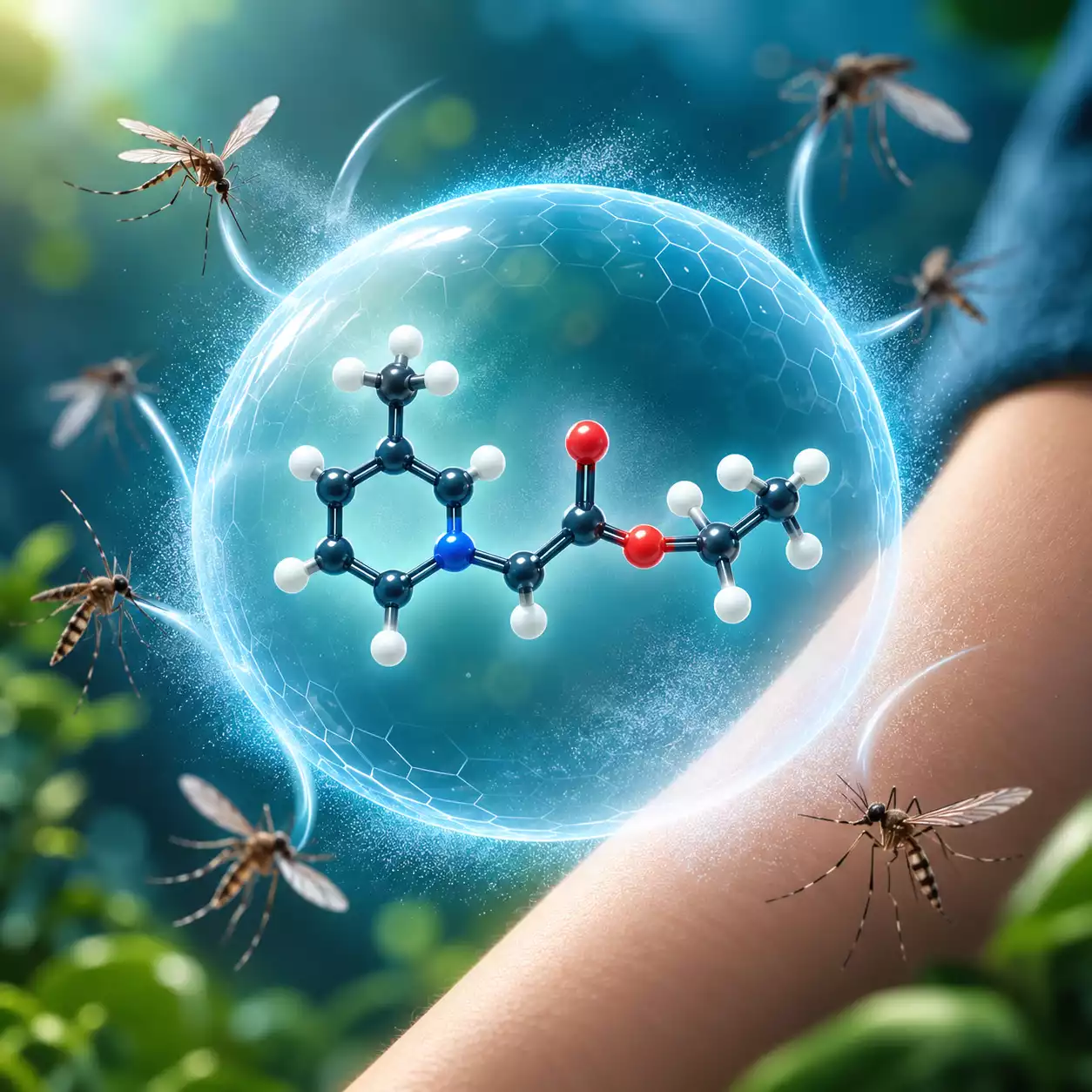
The truth lies in between: Picaridin is a synthetic compoundfrom the piperidine chemical group. Its structure is based on piperine, the compound that makes pepper hot, but it is made in a laboratory, not extracted from pepper.
Why this detail matters: if you choose Picaridin because you think it's “natural” and therefore safer, you're choosing it for the wrong reason. Picaridin is safe not because of its origin, but because its toxicity profile has been thoroughly evaluated. The EPA registered it in 2001 and found no evidence that it disrupts hormones.
How it works: it doesn't kill insects
Picaridin works like DEET in one key way: it doesn't kill mosquitoes, it stops them from finding you.
Mosquitoes locate a host by detecting CO₂, lactic acid and skin odor. Picaridin interferes with these receptors, making you “invisible” to them.
This explains why mosquitoes may still fly around you without landing. Repellents don't create a physical barrier; they confuse the insects' senses.
Protection time by concentration
Like DEET, concentration determines how long it lasts, not how strong it is.
| Concentration | Protection time |
|---|---|
| 5–10% | About 3–5 hours |
| 20% | 8–14 hours against mosquitoes and ticks |
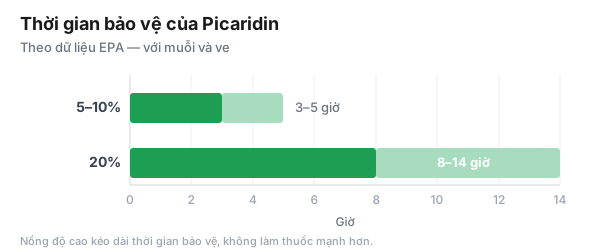
EPA data show 20% Picaridin protects for 8–14 hours. A 2010 study measured 12 hours of protection against ticks at 20%.
In Vietnam, the most common option is 20% , which is also the highest concentration sold at retail.
Two strengths DEET doesn't have
These are the most practical reasons to choose Picaridin.
It doesn't damage plastics or synthetic fibers. DEET dissolves many plastics, coatings and synthetic fabrics. Picaridin doesn't. If you carry a camera, GPS watch, glasses, rain jacket or technical pack, this makes a real difference: no need to worry about touching your gear after spraying.
Nearly odorless and not greasy. DEET has a distinctive smell and feels sticky on the skin. Picaridin is much lighter. For everyday users, or children who protest at strong smells, this decides whether they'll actually use it.
Age and safety
The CDC lists Picaridin among the active ingredients that can be used on children, together with DEET, IR3535 and 2-undecanone.
The CDC's general rules:
- Do not use any insect repellent on babies under 2 months. For them, use nets over cribs and strollers.
- From 2 months up, always read the specific product label, because each brand sets its own minimum age.
The 20% Picaridin products common in Vietnam are usually labeled for use from 6 months.
The EPA rates Picaridin as having low acute toxicity by mouth, skin and inhalation, and found no evidence of hormone disruption.
When using it: spray onto your hands and rub it on, avoiding the eyes and mouth. For children, an adult should apply it rather than letting them spray it themselves.
Weaknesses to know before you buy
This is the part promotional articles usually skip, but it matters for hikers in Vietnam.
Data on leeches are still very limited. Plenty of studies prove Picaridin works against mosquitoes and ticks. But for land leeches , the biggest nuisance when trekking in Vietnam, there are almost no field studies measuring how well Picaridin works.
That doesn't mean it's useless against leeches. It only means we don't yet have evidence to rely on, whereas DEET has several field studies on leeches in Thailand and Laos.
Practical conclusion: for leech forest, choose DEET. For everyday mosquito protection, beach trips, picnics or when carrying lots of electronics, Picaridin is the better choice.

When to choose Picaridin
| Situation | Good fit? |
|---|---|
| Everyday mosquito protection, gardens | ✅ Excellent |
| Shared by the whole family | ✅ Odorless, easy to accept |
| Carrying a camera, watch, glasses | ✅ Safe on plastics |
| Children from 6 months | ✅ According to the label |
| Travel, beach trips, light camping | ✅ |
| Leech-heavy forest | ⚠️ Choose DEET instead |
Suggested product: Sawyer Picaridin 20% mosquito repellent (89ml) : genuine US product, labeled for use from 6 months.
A combination many hikers use: Picaridin for the upper body and arms (where you touch your gear), DEET for shoes, socks and trouser hems (where leeches come from).
Frequently asked questions
Are picaridin and icaridin the same substance?
Yes, exactly the same. “Icaridin” is the name used outside the US. Saltidin, Bayrepel and KBR 3023 are also the same substance.
Is Picaridin a natural extract?
No. It's a synthetic compound whose structure is based on piperine in black pepper, but it isn't extracted from pepper.
Which is better, Picaridin or DEET?
It depends on the purpose. Against mosquitoes the two are equivalent at suitable concentrations. Against leeches, DEET has more evidence. Picaridin wins on smell and on being safe for plastics.
From what age can children use Picaridin?
Read the specific product label. The 20% products common in Vietnam are usually labeled from 6 months. The CDC advises against using any insect repellent on babies under 2 months.
How long does 20% Picaridin protect?
EPA data show 8–14 hours against mosquitoes and ticks. Reapply sooner if you sweat a lot or wade through water.
Does Picaridin repel leeches?
There aren't enough field studies to say for sure. For leech-heavy forest, use DEET.
References
- CDC — Mosquitoes, Ticks, and Other Arthropods (Yellow Book)
- CDC — Using Insect Repellent on Children
- US EPA — Pesticide Fact Sheet: Picaridin (KBR 3023)
- NPIC — Picaridin Technical Fact Sheet
Related: